
By Griffen O’Shaughnessy
Every growing business eventually hits the same wall: sales isn’t working the way it used to, and the instinct is to fix it by hiring. But according to Canopy Sales Strategy Expert Dan Greenberg, that instinct is often solving the wrong problem.
Why Traditional Revenue Teams are Struggling in 2026
After two decades building revenue functions inside companies like Twitter and LinkedIn, and years since consulting across industries, Dan Greenberg’s take is blunt: building a revenue organization isn’t hard because of strategy—most leaders can articulate a strategy just fine. It’s hard because of the process that’s supposed to connect that strategy to what a seller actually does every day. Add more headcount to a broken process, and you just get more people executing the same disconnect, faster.
How Buyer Behavior Has Changed the Sales Playbook
Part of the problem is how buyers have changed. Between AI accelerating information access and low-cost vendor switching, buyers now show up already equipped with most of what they used to rely on a salesperson to explain—and they treat every vendor conversation more like a transaction than a relationship. The data backs this up: cold call connect rates dropped 16% and meeting conversions dropped 31% in a single year; cold email open and reply rates each fell 25%. Worse, the standard sales pitch (“here’s how we’re different”) actively backfires in this environment. When every competitor claims the same kind of differentiation, buyers can’t tell who’s actually telling the truth, and the result is disengagement.
The Pod Model: A Smart Alternative to a Full Sales Team
The alternative isn’t a bigger team, it’s a smarter structure. Instead of stacking a traditional sales pyramid with a full-time head of revenue overseeing generalist sellers who do everything from prospecting to closing, the model centers on small “pods” built around specific cohorts of similar-behaving clients, rather than territories or verticals. Each pod pairs a highly skilled relationship-driven seller with an AI/tool layer for research and analysis, connected by an “operator” role that translates raw AI output into something usable, and feeds that field insight back into the tools. It’s a structure built on an old economic idea, specialization, applied to a part of the business that’s long resisted it: sales teams are typically asked to be generalists doing 12 to 20 distinct functions, when comparative advantage says they should be doing the one or two things they’re actually great at.
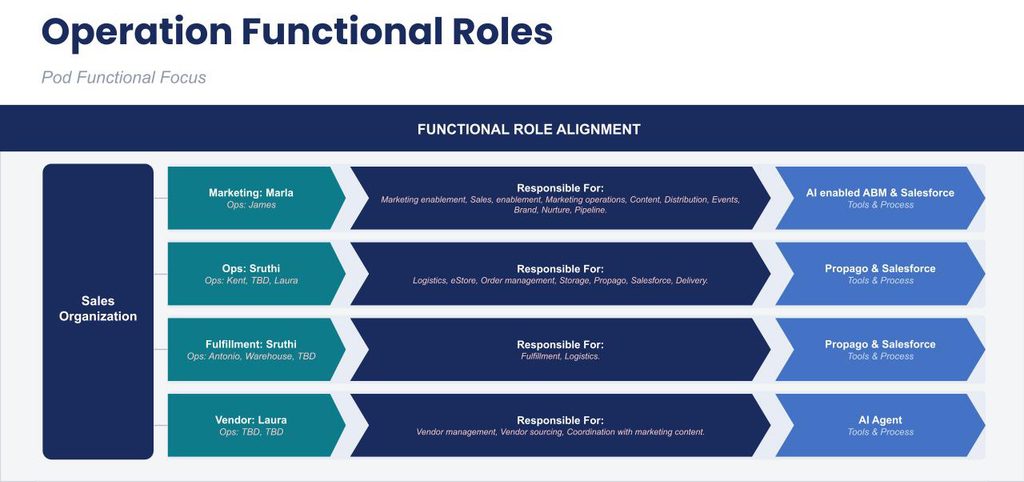
Here are two examples of how the pod model applies, in a revenue organization, and with a focus on function.

Why You Don’t Need a Full-Time CRO to Make This Work
Crucially, this doesn’t require a full-time senior executive to run it. Strategic authority can stay with a fractional leader who spends limited hours per week guiding pod leaders. But day-to-day execution authority moves down to the people closest to the client relationship, because they understand what’s actually working better than anyone sitting several layers above them ever will. This also solves a subtler problem: most companies run one generic sales process for every buyer, even though a warm inbound lead and a cold outbound prospect are at completely different stages of problem awareness. Forcing both through identical steps wastes a huge share of opportunities before the first real conversation even happens.
Scaling the Model: From Early-Stage Teams to $100M Companies
The good news for business owners eyeing this shift: it scales down as easily as it scales up. The core functional pattern—a skilled closer, a tool, and an operator bridging the two—can work with as few as two people, making it just as relevant for an early-stage or resource-constrained team as for a company approaching $100M in revenue. And in practice, the transition tends to be less disruptive than leaders expect, in part because most teams are already wrestling with how to fold AI into their workflow. Restructuring around that reality, rather than bolting AI onto an unchanged org chart, often feels less like a risk and more like finally solving a problem everyone knew they had.
Want to listen to the full breakdown, including live audience Q&A on how to define client cohorts and manage the transition? Watch the webinar recording here.
